The Paradise Within Reach
this article is four years old. It will be updated at some point
John Adolphus Etzler published The Paradise within the Reach of all Men in 1833, describing, among other things, detailed plans for harnessing the natural energy of the sun and the wind. It was clear to him that humanity had arrived, the long centuries of strife were done, the age of technology would now bring in a new age of freedom from want and drudgery.
Technological advance certainly happened, but alas not in the visionary way he’d envisaged. Technology didn’t free all men, but rather subjugated them more formally, for reasons which Henry George would come to explain later in the century. And technology wouldn’t embrace the energy that nature provides daily, but was fuelled from the world’s petrified and limited store of energy, the toxic, pounded remains of what had grown from the sunshine of millions of years before.
There is hope that now, finally – though in the meantime having, at the very least, severely affected the biosphere – humanity perhaps could be ready to make a leap that Etzler had felt was imminent.
So, Natural Energy, we say, or as it’s more commonly called Renewable Energy. Why natural? Surely coal and oil, and anything else, are natural. This is so, but those things as stored natural energy, rather than writhing and beating around us wherever we are. Our references to natural energy are about the live energy that is our environment.
When our name revealed itself to us, The Single Tax and Natural Energy Band, it seemed natural that the word was natural, it chimed so with the naturalness of what Henry George was describing. It is, natural energy. It chimed with the natural energy of humanity that would be released by the application of George’s insight.
So, some notes on some natural energy technologies, notes which are, again, nothing remotely comprehensive but our own quick flick through this world. A specific emphasis, though, on the work of Kitegen.
The idea of harvesting natural energy has been in the shadows over the last century, stymied in an era of apparently cheap hydrocarbons and being solely the preserve of enthusiasts. The technologies are fixed in many people’s minds as flimsy and unsubstantial, entertaining toys of eccentrics; it’s almost as if without toxic muck and danger and making a mess of the terrain, the energy produced can’t quite be real.
And if this energy is real, it isn’t reliable and so isn’t useful. It only works when the wind blows, or the sun shines. There’s been a credibility problem which is unwarranted, as these technologies and their possibilities have been kept down by the unseen and unaccounted subsidy upon, and the incalculable true bottom line of, the dirty fuels.
But these natural energy harvesting technologies are very real, and the potential is, and has always been, virtually limitless. They don’t poison the biosphere, and provide energy which is, before long, increasingly close to becoming free. It can be achieved with fairly basic and simple engineering and is potentially available to anyone, anywhere.
Despite the perverse lack of funding, the engineering has continued developing, often in an amateur way. Now it’s starting to make irrefutable sense, and we’d like to push that on as we can. In 2008, the total generating power of newly installed natural energy plants overtook the installation of new conventional plants for the first time.
This is desperately important because the era of a hydrocarbon-fuelled world has been deadly, most principally in terms of the distress caused to the biosphere, but also as the main driver of the disastrous relationships between the nations of the world, which have brought so much tragedy and injustice, made tyrannies of noble projects, and made an unhappy world out of what was a brilliant and delicate jewel in space, which was our blessing. In every way, oil has poisoned the world.
China, which has taken on much of the world’s manufacturing, now has such hellish air pollution in its cities that its scientists are comparing the smog to a nuclear winter, affecting the photosynthesis of plants. The Shanghai Academy of Social Sciences damned the capital, Beijing, as being almost uninhabitable for human beings. Also here and here. And the same thing is cutting crop yields in half in India. This is a real disaster that’s unfolding, now. If poisoning people isn’t quite enough to worry anyone, it causes real economic damage, as well.
Britain recently got a tangible taste of real air pollution recently, and it was truly nasty. But the real pollution these days in cities is usually tasteless and insidious, nanoparticles that interact with co-pollutants and then pass through every filter and become lodged deep in the body. Air pollution is another one of those things that looks worse every time it’s looked at. The actual death rates caused by from pollution get little mention in the world press, yet, according to World Health Organisation studies that are increasingly noticing the danger, one in eight of all deaths are now linked to it.
Whatever we’re striving for, is it really worth having if the price we pay for it is to utterly poison the environment in which we live? Is not the environment the most valuable and important thing any creature has?
But the technology has been around for decades which could harvest huge amounts of natural energy, and there are endless torrents of it. Human global total power consumption is but a tiny fraction of the natural energy in the biosphere. It’s just a question of taking it, of helping yourselves.
It’s long been the case that if the panoply of renewables could reach a certain critical mass, they would be obviously cheaper, close to free and available everywhere. But no great leap was ever made, despite the obvious guarantee of long-term success. Enthusiasts watched in dazed despair as obviously brilliant devices like Salter’s Duck and others were never floated, instead sank in the face of the apparent commercial reality of cheap coal, cheap oil, nuclear, all of which are massively subsidised if the true picture was accounted. Big industries with big political clout.
Washington-based campaign group Oil Change International, say on their website that they are:
. . . a research, communication, and advocacy organization focused on exposing the true costs of fossil fuels and facilitating the coming transition towards clean energy. The production and consumption of oil, gas, and coal are major sources of global warming, human rights abuses, war, national security concerns, corporate globalization, and increased inequality.
This site is their interactive tool that tracks the flow of oil, gas and coal industry money into the US Congress.
OCI have calculated that, for the year 2011, the industrialised nations subsidised their oil, coal and gas industries and the fuel consumers, to the tune of $58.7 billion. That’s what cheap energy actually costs to wage earners, before it’s taken from the pump, and that excludes any of the war mongering costs related to oil (which we’ll come to). A similar subsidy for natural energy technologies, even for just one year, would have a profound effect.
$58.7 billion? Research conducted within the IMF estimates global subsidies to hydrocarbon companies of $5.3 tn annually.
That’s $5.3 trillion; $5,300,000,000,000, a total greater than the entire world’s health spending. If anything should ever have been subsidised – as so much else has been – it is the technologies to harvest natural energy.
Of course, these subsidies and tax breaks and the like are nothing in calculating the true costs that oil has brought upon us. The full balance sheet would have to include the astronomic costs of military expenditure to maintain desired political positions in the supplier countries, and from this, the massively bitter price paid in the warping of the foreign relations of what we were brought up to think was the Free World, run by the good guys. The West, the Free World, is now morally bankrupt, its political heart blackened by its narcotic craving for the black stuff. Oil was never cheap, that was a mirage, it was just that few ever worked out the appalling true cost of it. Oil has been tragically expensive.
A lot of the money that flowed to the oil-producing nations, the Middle East, a region seemingly kept simmering in fear and uncertainty, was recouped by armament sales, further entrenching Eisenhower’s military-industrial complex which feeds from war and insecurity, further establishing their influence in government, furthering the quiet but steady militarising and securitising of politics and society. It’s really been the most vicious circle ever.
We can’t help repeating this, if only a tiny fraction of the rich world’s military and security budgets, or false security budgets, had been poured into the development of energy harvesting technologies, an abundance of natural energy would have been secured, and there wouldn’t ever have been any security problems; and it would have been very hard indeed to make any up.
The manipulation of power that has created this torn world is a large part of the oil story. Within the consumer nations themselves, oil has played a considerable part in concentrating wealth and power and establishing an absolute primacy of the creed of maximised wealth extraction above all other considerations, accompanied with a diminishing of individual freedom and agency. Our dependence on this apparently cheap energy has entrenched the logic of exploitative capital as the single goal of civilisation.
For reasons that are continually being underlined, there isn’t any doubt left that this era needs to be left behind as quickly as possible.

Dangerous Power
There’s an enormous and central political implication to how energy is generated. Energy generation is about political power and its concentration. Natural energy tends naturally to be small-scale and local, right down to micro-generation, and a correspondingly thin dispersal of political power. At the other end of a spectrum, nuclear power necessarily tends towards the creation of a police state, or at least necessitates a powerful, secretive and intrusive state, one that needs security, and engenders more secretive and paternal government, all of which presents the opportunity to assume powers to protect us from the highly-dangerous-in-the-wrong-hands materials they deal with.
The nuclear industry in the UK has its own police force, the Civil Nuclear Constabulary, which is funded by the private companies who run the UK nuclear industry.
Its website says:
The Civil Nuclear Constabulary (CNC) is an armed police force, keeping the nation safe from harm by securing the integrity of civil nuclear material.
What we really need to be kept safe from are the kind of societies engendered by nuclear energy. But it stands to reason, if you have nuclear power stations, then you’re managing a very big risk, so then you necessarily need security, and government and experts take more authority over affairs and start taking decisions on behalf of the people for their own benefit and protection. And then there’s a need to photograph people and keep files on them, making profiles on databases, that talk to databases, etc.
And aside from necessitating a security state, nuclear fission obviously is very dangerous . . . even if nothing can go wrong, the consequences should anything go wrong are several shades of disastrous. And things have gone wrong, from the Windscale fire and Three Mile Island to Chernobyl and Fukushima. We’ll come on to energy-harvesting kites more fully in a short while, but to say the extremely obvious here, kites have no potential for disasters.
The cost of nuclear power actually is enormous. We’re never really told the full cost, it’s always presented in different ways. Decommissioning a nuclear power station at the end of its life is a huge cost, but it seems to be on some different accounting sheet. The nuclear waste in the UK is another huge intractable public debt. The full cost probably isn’t really known, it certainly gets frighteningly bigger each time it’s mentioned, and each year it’s being stored under conditions of high security, by companies under pressure to cut costs and maximise return.
Why mess with that kind of thing if you really don’t have to? The obvious fact is, energy is everywhere, huge blooms of it are only a few hundred feet from you as you’re reading this, it’s just a matter of harvesting it. For some, even in spite of themselves, nuclear energy is an essential part of the transition from hydrocarbons to clean fuels, but it’s urgent to dispel this notion.

The Power in the Sky
With some expectation that these notes are being read by some in a sceptical manner, it may provoke mirth – initially – to mention that we think the most exciting area in the harvesting of natural energy is kite power, or more generally, High Altitude Wind Power, harvesting the powerful and steady winds of the troposphere. And we’re particularly excited by the work of an Italian company called Kitegen, for whom we wrote Kites on a Carousel.
It’s a very broad area which we’ll hardly touch upon here, but just run through a few of the emerging technologies in this field. Before we look at any others, a little taste of this promise of the Kitegen, before we even mention any of the other modalities of natural energy technology, because we think this is it.
Kitegen’s concepts may just be the complete solution to providing free-to-cheap, cheap-to-start-up, abundant energy anywhere, almost constantly.
The power that Kitegen brilliantly collect is high altitude wind power. This informative piece by Ugo Bardi, a professor in Physical Chemistry at the University of Florence, and associated with Kitegen, explains the field of high altitude wind:
The truly awesome power of the wind is found not at ground level but higher up, where it is far more powerful and constant. There are various projects around the world seeking to tap into this vast resource only a few hundred feet above our heads, a few hundred feet above our current wind turbines, up where the wind is really blowing. Average wind speed, and constancy, increases with height. And, the actual power held in wind increases by the square of the speed. So, if the wind 2,000 metres above is blowing three times the speed of the wind at ground level, that’s nine times the power; at four times the speed, it’s sixteen times the power.
Around the world there are now thousands of wind turbines, harvesting ground level wind, which does sort of come and go. If one of these big heavy turbine towers could be levitated just another 1,000 feet higher, the energy harvested would be eight-fold, and this would be coming almost constantly, with ever greater rewards of energy and constancy the higher the windmill could levitate. Alas, these expensive, fixed structures, each one built like a yacht, and all to catch the power of the wind at the bottom of the atmosphere, can’t be raised to where the wind really blows.
But, astonishingly, there actually are projects putting turbines in the air, there are windmills in the sky:
Makani Power, who have just been acquired by Google, have projects going on. Here’s a nice talk from Saul Griffith of Makani.
And also Sky Windpower:
Amazing picture of their FEG, Flying Electric Generator, and nice video on their site:

These are fantastic devices. And simple kites, as we know them, made of fabric, can soar around at those heights and receive enormous power, and there are plenty of people working out the best way of generating power from that.
Dutch astronaut Wubbo Ockels, at the Delft University, has been flying kites and generating useful electricity, and has come up with the concept of Laddermill.

http://assets.hardwaresphere.com/uploads/2008/08/laddermill-wind-power-generator-with-kites.jpg
The Laddermill will be extended a lot more, and it makes a lovely picture, here operating from a plinth in a park, where one might normally expect a sculpture. If it’s going to be as cheap and simple as this to harvest electricity from above, things are definitely looking up.
There’s a lot of work going on in this area at Delft University.
These are just two others that we noticed in passing: Enerkite are interested in strong winds between 100-500 metres. And NTS.
We’ve only recently seen this. This looks significant from Kitenergy.
And we’ve recently seen this, and this was a big thrill to discover, because we thought we had thought of this. Making a doughnut shaped balloon and putting a windmill in the hole is the fantasy behind Saving for a Sunship, which is now a song for Altaerosenergies, founded at the Massuchusetts Institute of Technology.
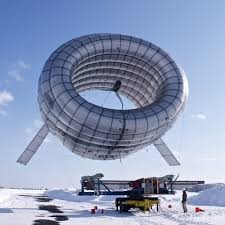
So, it’s not a Sunship, it’s a BAT, a Buoyant Airborne Turbine. It looks brilliant, and it can hauled around on the back of a truck and it keeps on generating all the while, whether airborne or not.
And, similarly, another imagined notion, something we saw a blogger imagine and the idea sounded very interesting, so we searched for such a thing and, lo and behold, someone has thought of it and worked it into a piece of engineering genius. This is Wind-it, whose windmills, or eggbeater turbines, could fit inside the hundreds of thousands of miles of existing electricity pylons.
A comment from Metropolis magazine on the Treehugger page:
Wind-it answers one of the greatest challenges to the development of wind power: where to site wind turbines. Choppin, Delon and Menard’s design uses existing infrastructure – the towers and pylons that dot the more than 157,000 miles of high voltage power lines in the U.S. – to locate their turbines, which can be stacked within already sited structures. Moreover, Wind-it solves the problem of linking energy generation and electricity transmission in the same way – by co-locating them.
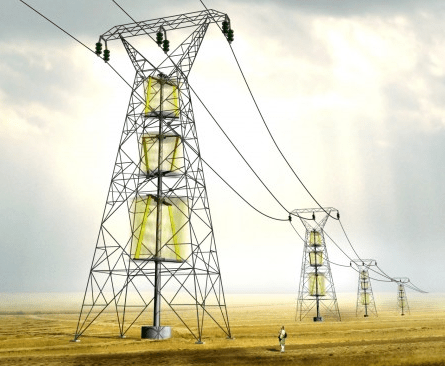
They don’t spoil the view any more than the view has already been spoiled. They retrofit the low to medium voltage pylons and they’re talking about generating 10kW each. Larger models generate up to a 1MW.
From the picture on this site it looks like about four pylons per mile, so about 628,000 pylons in the USA that could be retrofitted in this way. In Britain there’s 88,000 pylons, according to this petition to immediately adapt all pylons to include a turbine, and claims here that all of Britain’s energy needs would be met by the full potential of this.
Of course, Wind-It don’t really belong in a note about high altitude wind, but we’re not going to be mentioning ground level wind energy anywhere else, so we sneaked them in here.
Read more about Wind-It at wattnow:
And look at Doug Selsam’s amazing Sky Serpent, tens times the turbine, and, again, really obvious once you see it.
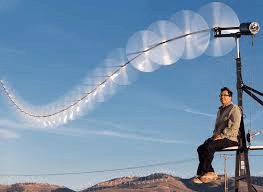
We can readily imagine Doug’s vision of Serpents many miles long across the sky. The idea would be much appreciated in China, maybe.
And at the very small scale, here’s an urban wind turbine that is light, cheap, simple to install, and suited to the twisty turbulent winds of a city. Ten million of these in a city would be easy to imagine and would maybe be making a GW at times between them. Of course, the imagination is running away now. But it is fair enough to imagine wind generators made anywhere with local materials; cloth sails and bamboo structures.
There are certainly many, many other ideas that have escaped our attention, time is tight. Time is tight in every way, so, clearly the most staggering promise in tropospheric energy or, indeed, any mode of natural energy harvesting comes from Kitegen. Kitegen are set to make a quantum leap in the harvesting of natural energy, taking from the vast power half a mile and beyond above.

Kites on a Carousel
Massimo Ippolito is an Italian engineer with broad technological research and development experience and he is the founder of Kitegen, http://www.kitegen.com/en/ based in Turin. He had noticed the huge energy caught by high flying kites and, working in the development of robotic systems, an idea developed with him over time, and has brought forth one of the technological revolutions of our age, what should be world-changing designs.
As part of a highly sophisticated control system, Ippolito has developed a kite-flying robot hand, informed by a combination of software and an array of avionic sensors on the kites and sensors on the ground. The robot hand has multiple kites whizzing around in precise predictive patterns, always maximising yield of energy, never crashing into another kite or getting their lines tangled. The Kitegen systems are actually kite-flying robots, guiding these tethered birds over predefined flight paths.
Kitegen have two main concepts, the Stem and the Carousel. The Stem is much the simpler, like a fishing rod with a thrashing fish on a line, but the fish is high in the sky. A single kite soars away, its energy captured and generated into electricity. When it reaches the top of its climb, its shape and configuration are changed, and it dives back to its starting position with very little energy expended. The rod rocks back and forth. It works like a two-cylinder engine, except that the power phase would be 90% of the action with a fast return to the beginning of the phase.
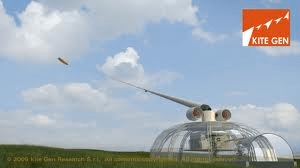
Even a simple Stem installation like this would be worth considerable generation, this is a 3 MW model.
We find the Stem grows in beauty with familiarity. We can imagine Stems built on top of high buildings. Stems actually seem like something that could be put in public parks, it would be an excellent attraction. A power station in a public park that sold tea and cakes. We can readily imagine them in public spaces. Cows could happily graze in a kite park, crops could happily grow.
This is a nice film of the Stem.
This is a larger Stem configuration. . .

It Iooks like Kitegen were thinking about a public park in this one.
This one is obviously many Megawatts more than the simple one, but with the more elaborate Carousel the power numbers start to be expressed in GigaWatts, which are strategic amounts of generation. More about measurement of power and context further on, because these wattages are confusing.
In the Carousel – which, charmingly, like the Stem, is an absurd looking contraption – a squadron of power kites stay aloft flying their set aerobatic routines and pulling a turbine around a circular rail.
They look low in altitude in this picture, maybe just to get them in the picture. In operation, they would be high in the sky performing their perfect figure-of-8 routines.
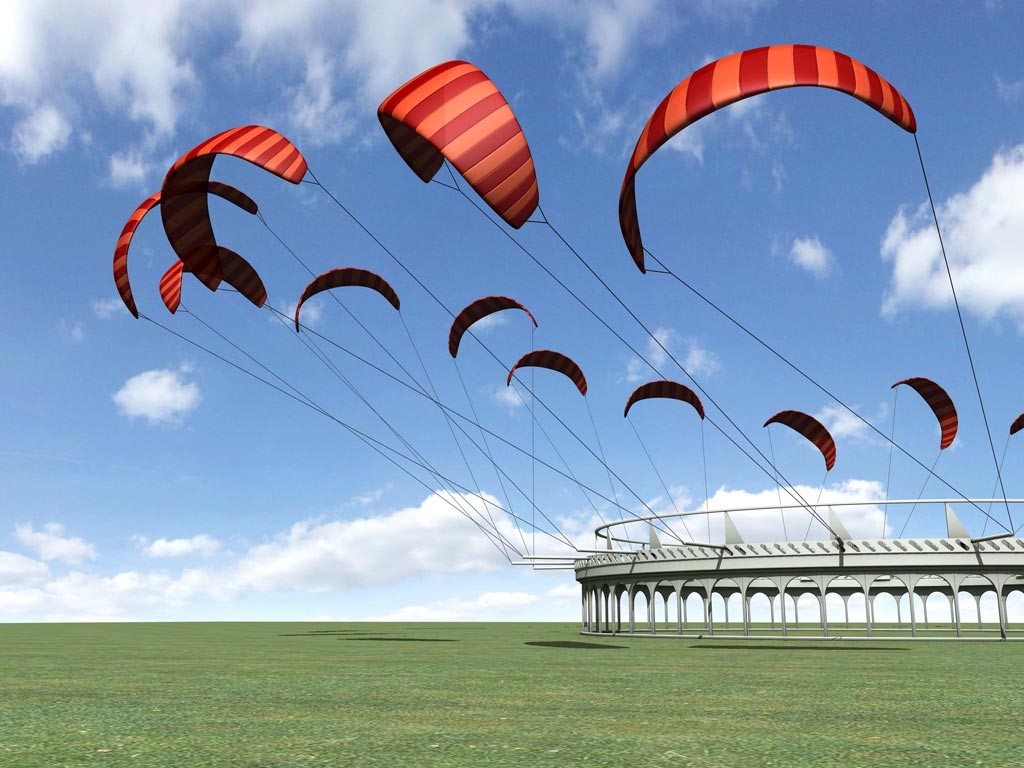
The power kites used by Kitegen are mass-producible, sure to be printable.
The following really does sound like fairyland, particularly so that it’s kites, but the world will see: 20 of these power kites soaring around high in the sky can rotate a 1,600 metre diameter turbine at 15 revolutions per hour, and that generates around a Gigawatt! What that translates to is that in the space taken up by a medium sized nuclear power station, this could be matched by a Carousel and its power kites, and for an estimated capital investment at least 10 times lower, and much, much, much less if all the costs were fully accounted. And much, much prettier and a lot more fun. It would be really cool if they would be lit up at night, it would be clearer to see exactly what was going on.
Drawing power from a cubic kilometre of sky, just about anywhere in the world, Kitegen’s Carousel will harvest a Gigawatt. The amounts of power harvested are so great that no country would have to do very much of it. Kites are very likely it.
And the Carousel is upwardly scaleable, and cheaply so. Once the plant is built, it’s just a question of adding easily assembled modules to it. Then, with expansion of the radius there is exponential growth in power. As the circular path is expanded, the area swept by the kites, and therefore the total return of energy, increases to the square, and the topmost kites are now reaching into higher and yet stronger winds. A 100 MW Carousel is calculated to deliver electricity at less than €0.03 per kWh, but that’s only the beginning. The 100 MW site can soon become a 1000 MegaWatt, or 1 GigaWatt, site. We’re certain the GigaWatt sites will be built one day soon, it’s surely irresistible.
Up through the heights to the very strongest winds, taking it to the limit of the sky, the theoretical maximum Carousel would be something like a ring about 16 miles radius, maybe like a railway viaduct, around which travels a Maglev Kite Gen. The power kites would now be touching the Stratosphere six miles up, moving in their dynamic and intricate formations, and now generating more than 60 GigaWatts. That’s enough GigaWatts for Britain at the moment. That’s a theoretical model, and a truly breathtaking one. But for now, the power of the wind a mile high is more than enough to be going on with.
As a dreamy indulgence, we can imagine a Carousel being raised on pillars and built right in the midst of cities. There will be people who would love to live in a neighbourhood underneath a Carousel and its swooping birds. And that would be more than enough electricity for the city. The district would have to be a no-fly zone, but, anyway, there’s plenty of places to build a Carousel, and it really doesn’t matter where it is, the same high altitude wind is going to be present.
After several tests and demonstrations, Kitegen had made a tender for their first big commercial deal, to power the aluminium smelter that’s the biggest energy user in Italy. Kitegen’s proposal was that a square kilometre, with 200 Stem generators, would do the job, provide cheap energy (about ¼ of the market price for electricity) with construction costs paid off in two years. This would have been the world’s first large scale tropospheric wind park. It didn’t happen, the plant has been mothballed by its owners. We hope it will happen soon.
Kitegen – and the world – really deserve a big break here. So, say Britain needs about 80 GW, to be on the safe side, and Britain is 244,000 Km2, then potentially she perhaps needs only to devote 80 Km2 to generate all her electrical energy. You’d think it would be worth having a punt on just one square kilometer somewhere, and you’d think someone in the square mile would jump on this; but maybe it’s not real things that attracts money now, there’s higher returns elsewhere.
After numerous trials, Kitegen have proven the concept. They are still working on perfecting the model further, optimal materials, etc., but the concept is proven. If a modest amount of millions can be raised, hopefully the next step is building a 150 MegaWatt park with 50 Stems. It just needs that first plant.
Really, public money should be poured into this, there’s nothing better you could do with it. It’s all going to happen anyway, but it would be great for the world if it happened quickly. Quickly throw up a collection of gigawatt kite parks and freedom will be glimpsed, a truly massive economic and social bounty will be there to take.
And kites on the horizon are not going to be an eyesore, they’d be a beautiful sight to behold. Why should not the answer to a central, existential question turn out to be something beautiful?
On all kinds of scales, from micro to macro, from 1 KW to 3 MW to 60 GW, surely kite power must happen. And Kitegen have a very special invention, a definite game changer.
Blogger Frank, on the Kitegen site, warns Kitegen:
Always beware that one day a fake “venture capital company” or “private equity company” will show up, which in reality will be a strawman of the big utilities, showing initial interest in your company, probably offering to “invest” or found a joint venture and as soon as they have the majority in shares they will try to bury your nice idea and never let it emerge again!
These giant utilities are a mafia who walk over dead bodies and have strong political connections!
If your concept becomes reality, they will lose billions of dollars in revenue.
Yes, they’ll lose everything, all the power they’ve taken which has corroded the high aims of government for the people, by the people. Of course, the powers of monopoly have buried so much before, and it’s well worth Frank mentioning that.
We wish we had the money to invest, a mere couple of billion would change the world inexorably, even a few tens of millions could have dramatic results at this stage. It’s a very creative looking investment. Fossil fuel firms spent about $650 billion in 2013 exploring for new reserves.
Really, the Italian government, the EU, pension companies, anyone; ideally, it would be 60 million or more individual people putting in €10, and this sort of thing will develop through the Web. This 150 Megawatt Stem park would be a banker, no question.
Surely Kitegen’s technology couldn’t now be buried in the way Frank fears, in the age of the WWW. It’s a cat let out of the bag and it’s been seen, that there is one clean and pure Gigawatt per Km3 anywhere to be had with kite technology. The Kitegen engineering is brilliant, tested, and the truth will out.
From Kitegen’s website, these are the scientific papers supporting the technology.
- Power kites for wind energy generation: fast predictive control of tethered airfoils – IEEE Control Systems Magazine, December 2007;
- KiteGen project: control as key technology for a quantum leap in wind energy generators – 2007 American Control Conference, July 11-13, 2007 – New York City, NY, USA;
- Control of tethered airfoils for a new class of wind energy generator – 45th IEEE Conference on Decision and Control, December 13-15, 2006 – San Diego, CA, USA
We haven’t said nearly enough about Kitegen, but fear not, we’re going to return to Kitegen at the end for some hard numbers.

What is a Joule per Second?
We do need a note about gigawatts and how power is measured to get some context, because it is quite confusing and it’s hard to keep the measures in mind.
What is a joule per second? a Physics teacher may ask, perhaps attempting to make a memorable pun out of the fact that a Watt is a joule per second, (a joule being a measure of power) and it’s in Watts that electrical power is measured.
1 horsepower = 745.699872 watts, so 7.5 KW.
A Kilowatt (KW) is 100 watts (kWh is Kilowatt-hour.) 1 KW would be enough to supply a home. Actually, though, in many different reports about what wattage is needed for a home, this varies from 1 KW to 10 KW. Anyway, a single kite taken out on a field by a couple of bods at Delft University can generate 10 kilowatts, and they reckon that to be enough for 10 homes.
A Kilowatt-hour (kWh) is what your electric bill will be expressed in. This is the power in kilowatts and the time in hours it’s provided for. We’re a bit confused about kWh, since watt already includes a measure of time, it’s a joule per second. So, is this joules per hour? We’ll have to leave this unresolved for now. With abundance of energy, this won’t matter anyway.
A Megawatt (MW) is one million watts. 10000 KW. A little e on the end, like MWe, means it’s electrical energy rather than thermal energy.
A Gigawatt (GW) is one billion watts or 1000 megawatts, this is a strategic unit. UK demand for electricity is about 60 GW, USA generating infrastructure is about 1,200 GW, that kind of figure. Kitegen claim they can deliver 1 GW from 1 Km3.
Beyond that there is Terawatt (TW), one trillion watts (1012, that is,10 with 12 zeroes) and the Petawatt (PW), one quadrillion watts (1015). Apparently, the total amount of mechanical energy in the atmosphere is calculated as 100,000 TWh, continuously renewed. The total power of the Sun that reaches the Earth is estimated at 174 Petawatts, (174,000 TW), continuously renewed.
It’s as plain as obvious can be, there’s an awful lot of energy going begging, that doesn’t need to be dug up and drilled for, rather to be reached out for, reach out for just the tiniest sliver of the energy there is around.

Dawn in the Desert
Natural Energy was screamingly obvious a century ago, and was decisively demonstrated, then obscured by the intervention of dire history. It was a lovely discovery to find that by 1913 all the engineering had been put in place by American inventor, Frank Shuman, to harvest 40% of the energy of the solar radiation hitting his solar collection troughs.
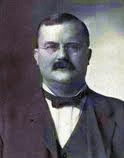
We talked right at the beginning of our notes, of Henry George’s insights in Progress and Poverty being what the Americans call a no-brainer. The story of natural energy harvesting has been another no-brainer, another enormous missed opportunity for wisdom in the world. And it was another visionary American, Frank Shuman, who did the engineering and the designing and the sums, and triumphantly demonstrated it in action in Egypt in 1913.
John Adolphus Etzler had glimpsed it in 1833, and it was a no-brainer to some like Augustin Mouchout in France, in the 1860s, that the resources of the world would eventually run out, and he and others strove to harvest the very obvious energy of the sun. In 1866, Mouchot presented a parabolic solar trough. Frank Shuman continued the earlier work and brought it to shining reality in 1913, in a work that stunned those who saw it.
Interestingly, Shuman was another Philadelphian, and a younger contemporary of Henry George. There doesn’t seem to be any suggestion that they knew of each other. Sadly, unlike Mark Twain, we can’t claim Frank Shuman as a Single Taxer – that would have been good – but clearly a man driven by a love of humanity and a concern for its future. And just like Henry George, Frank Shuman’s work is momentous forgotten history.
Frank Shuman was a very successful inventor in early 20th century USA with a long list of patents. He had become convinced that humanity’s future rested on the power of the Sun, and he set out to perfect its collection in a cost-effective way and urgently prove its case. He spent some years perfecting his sun engine in his workshop on Ditman Street in Philadelphia, where it became a big attraction for crowds of visitors. The 3.5 horsepower steam engine (about 2.5 KW) worked so well he left it running through the winter, and it kept working away, even on bright days in January.
He had realised that, in a simple trough, if it could be so perfectly insulated that none of the solar energy received in the trough escaped as heat, very soon the temperature in the trough would reach thousands of degrees. He achieved 40% insulation.
He was itching to scale his ideas up and, in 1913, he gained a commission to build the world’s first solar power station at the Cairo suburb of Maadi, on the banks of the River Nile. And here it is, the world’s first:

http://www.thenational.ae/storyimage/AB/20110122
He assembled the plant in a few months, cheaply, using local materials, and a simple design, with elegant systems to absorb the stresses of expansion and contraction in the hot sun, and for the seven rows of collectors to track the sun as it moved across the sky. The rows of curved mirrors rested on metal cradles and held before the raging Egyptian sun. The sun’s rays were reflected onto a thin glass pipe filled with water, producing steam pressure that drove pumps Excess hot water stored in a large insulated tank kept the plant running for 24 hours a day. This was 1913.
A grand opening was assembled, attended by Lord Kitchener, British Consul-General and administrator of Egypt, and ambassadors and other dignitaries. After a splendid lunch, he set his collectors to collecting and, utilising the power of the sun falling on a few acres of the Earth, 6,000 gallons of water a minute started gushing from the Nile into the surrounding fields.
This was a heady success; Shuman stood before the world’s first commercial scale solar power station, using natural energy to do work that couldn’t previously be done without expensive fuel imports. Shuman had delivered, and he could point to his creation and spell it out to the world:

(images: Wikipedia; New York Times screenshot, 1913)
Straight away, the implications were evident to his audience. The mightily impressed Lord Kitchener gave Shuman 30,000 acres in British Sudan on which to build a much larger solar plant. The German government, whose ambassador had attended the opening, straight away gave Shuman a $200,000 contract to build plants in Namibia.
The full story is here and here . . .
And this is how it was reported at the time in The Egyptian Gazette:
Frank Shuman had also said:
Solar power is now a fact and no longer in the “beautiful possibility stage. [It will have] a history something like aerial navigation. Up to twelve years ago it was a mere possibility and no practical man took it seriously. The Wrights made an “actual record” flight and thereafter developments were more rapid. We have made an “actual record” in sun power, and we hope for quick developments.
So, actual record, Harry Shuman’s feeling starts to strongly recall Henry George’s: look, it’s there, it’s obvious, it’s demonstrated, and it’s obviously what’s going to happen now because its sense is undeniable. How could the world possibly take a different course of action? It’s just nonsensical that it could go any other way. There is the actual record.
Colonial Africa seemed poised to become a solar farm. Shuman felt that from here on in, it was going to be like powered air flight and take over the world.
Then, an Archduke was shot dead, and the world descended into the insanity of World War I, and war and oil took over the world instead. In an act of sickeningly symbolic vandalism, the solar collector troughs of Maadi were broken up to support the British war effort. The huge German contract was now worthless. And the war then entrenched coal and oil into the industrialised economics, and the war’s increased demand for both these pernicious products had lowered their cost. The toxic treadmill which the world has been on ever since, with all its terrible self-feeding consequences, had started rolling.
Two Philadelphians, Henry George and Frank Shuman, have provided the biggest what-ifs in history. It doesn’t feel fantastical to claim that these particular what-ifs are the very ones that would have led to a perpetually prosperous and just and happy world at one with its planetary home, respecting what it is.
It is actually quite nice to ponder that the world might have turned out well. And it might have been so much worse; it was maybe not beyond the Victorian era to have invented CFCs and incinerated us all before anyone knew what was going on. We might have accidentally destroyed ourselves and never have known why. Perhaps this happens sometimes in the universe.
We’re still here, but suffering from having took the wrong steps years ago, particularly between about 1884 and 1914. If that 30 year period could have been magically different, this would have been by now a world of liberty and plenty much further advanced to the troubled one we’re imprisoned in. It is just a fantasy, but in the world of what-ifs, these two really are the big ones. The world really could have turned out very well.
One day it may be seen as ludicrous that it didn’t, that this era be seen as an era of magnified madness that we found our way out of. The world really could have turned out very well, and we’ve got to believe that it still could.

Concentrated Sunshine
Frank Shuman had planned to return to the desert, but unfortunately he died in 1918. He’d had great far-ranging plans. He had sketched out designs, solar plants on a vast scale. He wanted to take 20,000 square miles of Sahara Desert to permanently provide the world the 270 million horsepower per year that equates to all the fuel burned in the world in 1909.
So, by our calculations, 270 million horsepower = 201,420,000,000 watts, and a Gigawatt is 1,000,000,000 watts, so, 201.4 Gigawatts is all the fuel burned in the world in 1909. The reader shouldn’t trust the maths, but it seems plausible. Anyway, about 20,000 square miles of desert was, in 1909-13 times, required to generate all the world’s energy.
In 1986, 73 years on, with the world’s energy demands now so much greater, and the dangers inherent in the world’s satisfaction of these demands so much greater, a German nuclear physicist, Gerhard Knies, calculated that an area of desert the size of Wales could power all of Europe. Wales is 8,015 square miles. This all seems roughly consistent, and suggests that, in the intervening 73 years, the conversion rate of sunlight to power hadn’t improved that much on Shuman’s 40%.
Knies had been alarmed in 1986 by the catastrophic nuclear accident at Chernobyl, in the Ukraine, then part of the old Soviet Union. An explosion and a fire sent radioactive particles all over Europe. The long-term effects of this cloud are still being monitored and accounted.
Chernobyl was a Level 7 event in the way these things are rated, the only other Level 7 event has been Fukushima in Japan in 2011, which was followed shortly by Germany’s renouncing of nuclear power.
Amidst the fall-out from Chernobyl, Knies decided to calculate how much of the constant power reaching the Earth was required to power human civilisation. His research led him to the staggering realisation that in just six hours, the deserts of the world are hit with more energy from the Sun than human civilisation needs for a whole year.
It really is a no-brainer, that’s how much of no-brainer all this has been. Knies saw a way to leave dirty and dangerous fuels behind in our history, just a dangerous age – that Shuman might have nipped in the bud – that we could move beyond. Again we hear the same note of frustration echoing from down the years, from Henry George’s frustration at a world that failed to embrace a simple and obvious truth for its infinite betterment, Gerhard Knies asked whether we are really, as a species, so stupid as to not grasp this wonderful gift.
For the next 20 years Knies became a solar evangelist, a man with a mission, and often it was another one of these lonely quests, banging on the doors of the world. The eventual fruit of his endeavour was the Desertec Foundation. Then, in 2009 an international consortium of companies formed Dii, the Desertec Industrial Initiative. Dii had some heavyweight companies on board, and the whole project started gaining some credibility in the face of many questions.
Desertec’s vision is for a network of solar and wind power plants right across the MENA area (Middle East and North Africa) to provide abundant electrical energy to the whole area. Electrical power can be transmitted over long distances by direct current transmission, which loses only about 3% of the power every 1000km, and nowhere on Earth is more than 3000km from a desert.
Desertec urge the integration of Europe’s renewable energy resources with new smart grid technology, which enables two-way exchange. Fukushima certainly put more wind in Desertec’s sails, along with repeated clear warnings that the world is bound for irreversible climate change without urgent and immediate carbon emission reduction. It’s definitely time for bold steps.
This is one of Desertec’s graphics:
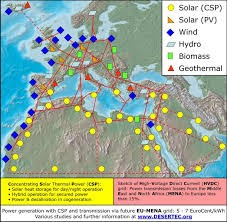
The Desertec concept is of a global mix of renewables and this is a natural energy map of Europe, showing the diverse strands of energy harvesting that could be linked together to provide a robust system of supply to the whole EUMENA area (Europe, Middle East, North Africa.)
This graphic doesn’t include the virtually unlimited potential of kite power, and its potential harvest could be anywhere, a kite symbol could appear anywhere on this map. It also doesn’t include huge wave and tidal potential, about which more later. The map shows two kinds of solar power, and Desertec are principally about CSP, Concentrated Solar Power.
In the 2nd Century, Lucian wrote that Archimedes had set fire to Roman ships during the Siege of Syracuse, using what a later historian, Anthmius, called burning glasses, focusing the rays of the sun onto the ships. Mythbusters busted it, though a Greek engineer did an experiment in the 1960s with the help of sailors of the Greek Navy holding polished bronze shields, which produced some conflagration. And in the 15-16th century, one of Leonardo da Vinci’s visionary ideas was the use of concave mirrors to concentrate the sun’s energy to heat water; and also as a death ray, though that’s not the idea we wish to propagate.
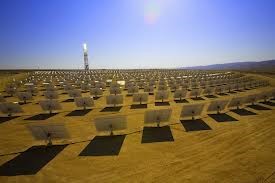
The kind of thing that Archimedes was imagined doing is sort of what Concentrated Solar Power is about, which uses hundreds of parabolic mirrors to concentrate the rays of the sun to a single point, creating vast temperatures to superheat water, or whatever working liquid, to create steam to drive turbines. Tremendous heat can be stored in molten salt and keeps the plant producing electricity 24 hours a day. It’s essentially simple technology.
There is also widespread use of the kind of solar troughs, descendants of Shuman’s troughs, that superpower funds were set to pour into in 1913.
This explains further the basic tech.
There have been several large CSP units working in Spain and the USA for some time, and it looks like this:
Desertec have had their ups and downs, some partners have pulled out, though new ones have joined. It was worrying to hear that the Desertec Foundation have split from Desertec Industrial Initiative, there were apparently communications difficulties between the groups about the focus and emphases of development. There have been some criticisms. The whole idea has always had huge problems to surmount, it’s a very problematic world.
[Desertec] is not viable in its original form because it is too expensive and utopian.
So said Peter Droege, president of Eurosolar, an industry association. They are the European Association for Renewable Energy
We see he has a point, certainly, and we’re certainly not criticising his observation, but we were struck by the use of utopian in a negative sense. Surely an ideal society is what we’d definitely choose if there was one to be had. Is Utopia too much to ask? Have we had it knocked out of us to stop wanting that? Stop even imagining it. Yes, it is utopian. Utopia is there to be had, if we could find a way to get there.
The hard-headed and all-pervasive logic of capital and militarism and addiction to oil has become a straightjacket on our imagination and our courage. Utopia is surely what we want. It certainly would be very expensive to go out now and totally fulfill the Desertec vision, but it would be a once-and-for-all investment, and then energy would be free-ish, certainly not a security worry of any kind. 400 billion, whatever . . . Such sums will be spent, and they’ll be spent on false security. 400 billion is cheap for this, the EU should just fund it, chuck the entire EU fund at it, and build a direct current smart grid. The benefits would be incalculable, utopic, even eutopic, it’s still hard to resist a pun.
Anyway, Desertech have created plenty of interest in what they’re saying, and hopefully these miscommunications are straws in the wind as there is so much abundance, so much space to move into.
This is a little video from the Desertech Foundation:
There’s surely too much momentum now, Shuman and Kneis’s revolution has begun. It has started happening at scale and it will spread, into empty space. What is never going away is the blinding fact that six hours sunlight falling on the world’s deserts is enough to provide all the power the world needs, and surely that idea is eventually irresistible.
Continuing technical development will increase its reach, make it much less water-thirsty, make cheaper, lighter, maybe sand-resistant mirrors. (Among many others, a company called Skyfuel, coming up shortly, have some advancement in the area of materials.)
The idea should run away, maybe it’ll be something that any villagers anywhere can do, make their own CSP plants, cheaply, maybe scaled-down versions, and without expensive industrial mirrors but something much less efficient, from local materials, but efficient enough to generate useful wattage. Maybe 3-D printing could have a lot to do with doing that.
Here’s the wikihow article on making mirrors.
There is the idea of micro-CSP, a term coined by a company in Hawaii called Sopogy who make small units which come in a flat pack. And here’s an excellent 2½ minutes on YouTube, explaining how the technology works.
Sopogy are building a small plant to power 500 homes, Keahole Solar Power in Hawaii.
The company says:
Once the first phase of the project is completed, Keahole Solar Power will produce electricity for over 100 homes. The one-megawatt solar farm will be capable of powering 500 homes and offsetting over two million metric tons of carbon dioxide emissions.
See more here:
A tiny little plant, supplying just 500 homes (1 MW) offsetting two million metric tonnes of carbon dioxide, two million tonnes! It’s really hard to visualise two million tonnes of carbon, but these are the sums given here.
And then we read this, to remind us that you have to be careful what you read always. Sopogy were using projections that violated the second law of thermodynamics, which is a problem. Still, Micro-CSP still sounds a worthwhile phrase.
We mentioned a company called Skyfuel, and there’s a beautiful picture we can get in here:
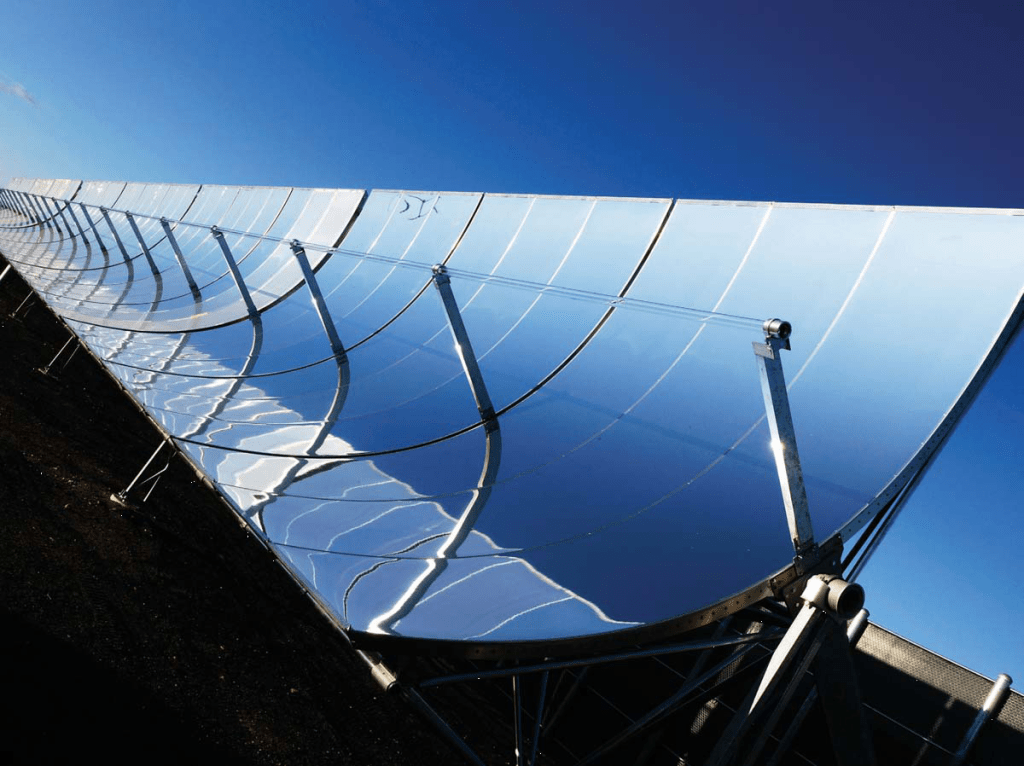
This is their Skytrough, and they’ve developed a special mirror film, ReflecTechPLUS mirror film, that’s cheap, unbreakable and lightweight and they’ve made this really light and simple kit for a SkyTrough to be shipped and assembled, light enough to be carried about, and suitable for generating electrical power or produce desalinated water, as single units or banked together.
There are many groups active in all these areas and improvements in all these technologies are exploding and this is just one example.
Back to the vast and abundant desert, this is an image from Morocco’s Ouarzazate project:
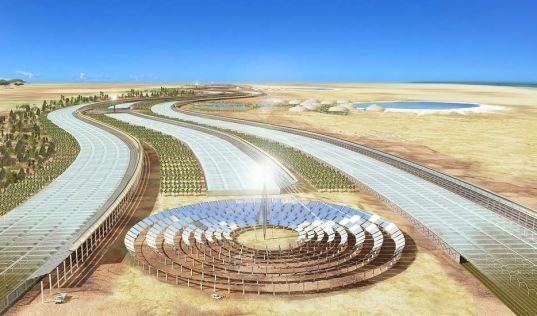
. . . and there’s plenty of desert in this picture that’s doing nothing except being shone upon.
We had read about a Dii plan for a 12 square kilometre 500 MegaWatts (½ GigaWatt) solar farm close to Ouarzazate in the Moroccan Sahara. (So, 42 MW per Km2.) This was to be a reference project, to demonstrate how such plants could be reproduced anywhere right across the region.
Kitegen would eventually be looking to get 18 GigaWatts out of 12 km2. CSP and Kitegen could be happily combined, of course. Indeed, a CSP array would fit neatly inside a Carousel.
Morocco is advancing its solar projects with the help of Spanish engineers, who are the technical leaders in CSP. It’s there to do anywhere in any empty space hereabouts, the Sun spreads its favours evenly on every grain of sand. Morocco have got a lot of empty desert.
Morocco plans to go from 97% dependency on energy imports to 42% self-dependence on renewable energy by 2020, which would represent a massive leap and a compelling example; but they’re bombarded by energy and should be going for 200% self-dependence straightaway and export electricity, and then 300%.
And it’s great to be able to update on Ouarzazate.
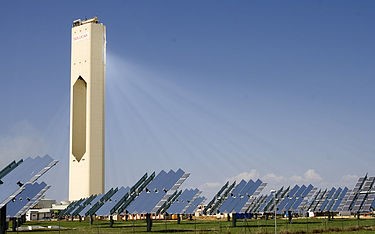
Spain has been the world leader in CSP. In 2007, the world’s first commercial concentrated solar power tower, PS10, was built near Seville, producing a modest 11 MW. It cost €35 million to build and produces revenue of €6.3 million a year. After six years, it’s money for sitting about and doing a bit of mirror cleaning.
Andasol 1 came in 2009, Europe’s first commercial parabolic trough park, and other such plants and towers have followed. All the money has run away in Spain as everywhere, and this is sadly slowing the development of the industry here and around the world and the technical advances that are there to be made.
But by the end of 2012, Spain had built over 2,000 MW (2 GW) of CSP, with 4½ GW planned. It’s a very good start. Spain are also heavily into photovoltaics, more of which later.
Worldwide, about 17 GW of CSP harvesting is under development, led by the USA, Spain and China, and at least ten other countries are building CSP plants. All of this should have happened decades ago, starting from Maadi.
The USA has a handful of solar thermal sites, Nevada Solar One has been online since 2007. SEGS in California was the world’s largest, with three sites in the Mojave Desert producing 354 MW (0.35GW). In February, 2014, Ivanpah Solar Power Facility in California, in the middle of Death Valley, was completed, trumping that with 392 MW (0.4GW).
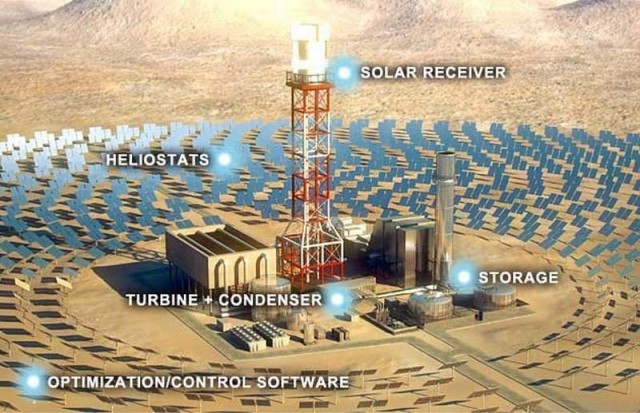
Ivanpah was built by Bright Source Energy.
Arnold Schwarzenegger, ex-Governor of California, said at the opening:
There are some people that look out in the desert and see miles and miles of emptiness. I see miles and miles of a gold mine.
But here’s an article that says rather unkindly that Ivanpah is already irrelevant. The author’s point, though, is in the context of the dramatic collapse in price of photovoltaic installation. And, of course, hurrah to that as well, another form of natural energy collection is becoming so good that it’s making Ivanpah – which is making 392 MW out of land that wasn’t doing anything before – irrelevant. If Ivanpah is irrelevant, then surely hydrocarbons and nuclear are. Stranded assets?

Photovoltaic
Google have been heavy investors in CSP through their RE<C programme, (Renewable Energy cheaper than Coal)
They put $168 million into Ivanpah, but whilst they continue their work in improving Solar Power Tower technology, and have published research on how costs here could be reduced still further, the dramatic decline in the cost of photovoltaics have persuaded them to put their investment in that area and they do not plan to invest further in CSP projects.
It was always going to be the case that as soon as a certain scale of manufacturing was achieved, the cost of photovoltaics and other natural energy technologies would plummet. Scale and anticipated technological improvements will now push the costs lower and lower.
Just up the road from Ivanpah are the photovoltaic arrays of the Antelope Valley, Solar Star Projects, which will be the largest solar photovoltaic project in the world, eventually producing 579 MW. That is a good number.

Photovoltaics are the other kind of solar power, and the kind most people would be more familiar with, solar cells and solar panels. They’ve been around a long time. The photovoltaic effect was first demonstrated by a budding 19 year old French physicist Edmond Becquerel as far back as 1839, the year Henry George was born.
In 1883, American inventor Charles Fritts, came up with an actual working solar cell, with an energy conversion efficiency of less than 1%. His contemporaries called him a fraud, that he claimed to be generating power without consuming matter, thus violating the laws of physics
What’s happening here is a lot more involved than using mirrors to concentrate sunlight:
Photo means light. And the whole basis of life on Earth as it is, why the Earth is suitable for the suite of life it has, rests entirely upon what green leaves have been doing for hundreds of millions of years: photosynthesis. A leaf is a solar harvester, converting sunlight into chemical energy that fuels the plant’s growth, ultimately providing the food for every living creature on Earth, except the extreme ones.
Solar photovoltaic cells convert sunlight into an electrical charge. In Photovoltaics, Sunlight excites electrons in a semi-conducting material so much that they become free, and can be made to generate an electromotive force, and hereby sunlight is converted into electrical energy.
A number of materials can be used as semiconductors, various forms of silicon and others. The explanation for exactly what’s happening here is in the realm of quantum physics and we’re not going there, but semiconductors are materials which have electrical conductivity in-between being a conductor and being an insulator, a property which makes them the foundation of electronics.
Cells containing these semiconductors are put together onto panels. The manufacturing of these panels, assembled into arrays, has grown enormously in recent years. By the end of 2012, 100 GigaWatts had been installed worldwide over at least 100 countries, and there’s a lot more coming.
This is some serious gigawattage. Despite the pessimism of many, it might turn out to be a question of which mode is going to swamp the world in abundant clean energy first. There could be huge surpluses eventually, which could be put into extracting carbon from the air.
It’s very cool that solar cells produce more electrical power when they’re played pop music. We think further research should be done in this area and would humbly offer our services.
It was a real pleasure to come across this. André Broesse, a German engineer in Barcelona with Rawlemon, has been designing, and has produced this beautiful object:

It’s a solar sphere. Their latest model of it is the Betaray. It tracks the sun across the sky and is 35% more productive than conventional dual-axis photovoltaics. It can concentrate light 10,000 times, not only sunlight, but moonlight! This is lunar power (okay, reflected solar power.) The design can actually generate electricity from moonlight. That’s going to inspire a song sometime. It will work anywhere, under cloudy skies. That’s just so beautiful.
This is Rawlemon’s little film about everything, and read more on this beautiful page here:
The Betaray is designed to be built into buildings. It looks completely portable, and downscaleable, it would make a superb paperweight. And we can imagine it scaled up, as well, some giant ones. It will be printable one day soon.
Staneb have a suggestion: the solar sphere is made of glass, but maybe the sphere idea could be combined with Skyfuel’s ReflecTechPLUS material, and make it lighter and cheaper and even more beautiful.
The ideas keep exploding. There’s some fascinating solar innovations here
In this article, Rob Wile has a figurative Solar Olympics 2014. The USA takes bronze with 5.3 GW installed, Japan take the silver with 7.5 GW, and the gold goes to China, installing 12 GW of solar power.
But to really see mass solar power in action, the place to look to is Germany, gold medallists at the previous two figurative Solar Olympics, so they’ve already got plenty installed and basking.
No brochure has ever exhorted tourists to Come to Sunny Germany, yet this is where natural energy technologies are really, finally, coming into their undeniable own. The pie really is not in the sky, it’s in Germany.
Germany has been hailed as the world’s first major renewable energy economy. They have set a course to become the first industrial power to generate 100% of its energy from renewables. Currently, just over 25% of electricity supply comes from natural energy (more than from their nuclear plants), and by end 2011, Germany had installed about 66 GW of renewable energy.
May 25, 2012 was a big day for solar power, which supplied 22GW into the German power grid, equivalent to 20 medium-sized nuclear plants. On this day, for the first time ever, 50% of the midday electricity demand of one of the world’s foremost industrial nations was being provided by solar power.
This is the kind of thing to be seen in Germany:
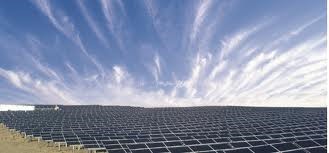
This is a stark comparison with what is still the UK’s basic stance towards natural energy. All this looks expensive, but in fact it’s very cheap before long; just as what has always seemed cheap was actually hugely expensive in the end; hugely.
Germany is acting with great decision. The situation is that, at the moment, Germany has high electricity costs; but they would seem to understand fully well that if they stick with it, their vision will be rewarded with spectacular returns, and the country will be clean and the air sweet. And when Germany has been through this process, they will stand as a bright beacon to their neighbours, and the whole suite of technologies will bound forward and become much cheaper still. It is an act of great courage, but on the other hand, to not so act is great foolishness. It’s the grossest negligence not to follow Germany’s lead. And Uruguay‘s.
And if these pioneering countries want to take a great leap forward in what they’re doing, they’ve got to investigate Kitegen.

The Writhing Sea
Kites, CSP, Photovoltaics, any one of these would be plenty; plenty; and to not even cast a glance at the colossal energy writhing in the sea.
The UK is battered with wild natural energy. And it’s a sad fact and another no brainer that, in the 1970s, the UK squandered a massive chance to take a world leadership in natural energy the way Germany has done.
The UK first nourished and then abandoned the ingenuity of some great British engineering, wilfully and absurdly cooking the books to deny the clear evidence. This is the story of Salter’s Duck.
In the 1970s, following the oil crisis, the UK government started a research programme into a range of renewables, particularly wave energy, and various designs were produced.
After a technological career including aircraft, rockets, the early hovercrafts, electronics and robot mechanics, Stephen Salter was Professor of Engineering Design at the University of Edinburgh. In 1974, he invented what became known as Salter’s Duck, arising from studies including those on a lavatory cistern (but nothing to do with Toilet Duck.) After extensive testing in wave tanks he had designed and built, he had a prototype of what was then the Edinburgh Duck built by 1976.
http://www.marketoracle.co.uk/images/Kitley_17_5_07_image002.jpg
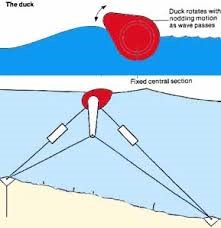
This illustration describes the process. The narrow end of the duck faces the waves, which make the ducks bob up and down with a nodding motion. This motion can be converted into mechanical energy with an overall efficiency of up to 90% of the energy of the waves (down to 50% in calmer water.) And there’s various ways of converting this energy.

Okay, it’s just an artist’s impression, but that’s not its fault! It can be seen here what’s happening, all the energy in the sea beyond has been absorbed by the Duck and converted into mechanical power, leaving the water behind it calm. You almost don’t have to do any sums, you can get a feel of how much energy could be harvested out of a few miles of ducks. Stephen Salter had done the sums, of course. He said:
The average 3-meter high Atlantic wave with a period of about 10 metres from crest to crest has a power of about 90 Kilowatts per meter width — enough electricity for 180 UK residents. Four hundred kilometres of the Scottish Atlantic sea front could contribute 20 to 40 Gigawatts.
250 miles of ducks in a row could yield 20-40 GW; one concentrated engineering effort – in a country that invented engineering – and a third to two-thirds of the energy for this island is generated. With such promise, this must have been a very exciting project to work on at the time.
Alas, in 1979, a change of government brought a big change of focus, and even the paltry sums that were spent on wave R&D programmes were cut off. Nuclear power was to be bought off the shelf, and soon there was even a perceived oil glut, strangely enough, so that was the end of the programme. But it had to be buried by an astonishing piece of destructive accountancy.
Five years of research on the programme had gone very well and the Duck was getting very close to mass production and deployment. Clive Grove-Palmer was a government engineer and had been a staunch and enthusiastic proponent of nuclear energy in his time at the UKAEA, the United Kingdom Atomic Energy Authority. Somewhat bizarrely, the government’s renewable energy programme was under the auspices of the UKAEA. Moving within the UKAEA, Grove-Palmer became project leader of the wave energy programme, and soon became an adherent and an authority on Stephen Salter’s engineering.
He vigorously campaigned for the deployment of the Duck, making the assertion that the cost of electrical generation would soon be driven down to an unbeatable 3.3p/kWh. But there were people who really didn’t like what he was saying.
In 1982, a government conference was set, a secret briefing, to discuss the future of wave power. To his outrage and astonishment, he hadn’t been invited to the meeting; the government were to examine and discuss wave energy without the head of the programme there.
It was immediately clear to him that the government had called the meeting for the purpose of ending the programme. It would have been necessary to exclude the engineer who could lay out the technical evidence that this new technology was ready to go and was a much better idea than nuclear energy on all counts. The programme was shut down in secret session.
Grove-Palmer took early retirement in disgust, and later said:
I resigned … because they asked me to write the obituary of wave power. There was no way I could do that … We were just ready to do the final year of development and then go to sea.
He became as vociferously anti-nuclear as he had been pro-nuclear and aghast that this ingenious piece of British engineering, which would efficiently harness the energy surging around Britain, had been killed off. Not even winning on price was enough against the forces that wanted the Duck dead.
The wave power team didn’t even see the report which had damned their work for many months. When the report came out, the true production figures of the Duck had been obscured by averaging the figures for all the wave power projects that were going on, and thus contrived the bloated figure of 8-12p/kWh.
They must have been fearful of the Duck, because they kept kicking it, kept cooking up lies about it. Next came a report about the Duck which massively underrated the performance of undersea cables; that had costed each Duck in a production run at the same cost as the prototype model; had overestimated the capital costs by a factor of 10. Decimal point in the wrong place, it’s easily done. It should have been concerning, though, that people in the nuclear business could make miscalculations to a factor of 10.
Up until 1982, wave power was a publically subsidised initiative, but wave energy research really existed on crumbs. 1980-81 had actually been the high water mark of government investment in renewables, which – under the auspices of the Atomic Energy Authority – invested £17.3m for all renewable energy projects. The context that public subsidy needs to be seen in is that, in the same year, £203m was spent on nuclear energy R&D. This is how it has always been for renewable energy.
If only £200 million had been spent on the Duck in one year, there could have been a lot less nuclear waste accumulated in the UK, which instead would have had a world-leading engineering sector and been a trailblazer for a way to clean energy. As more capacity was added, and the engineering developed, the costs would have continued to travel downwards. Salter wanted to build them out to Iceland, and the world would have been a somewhat better place if they had been.
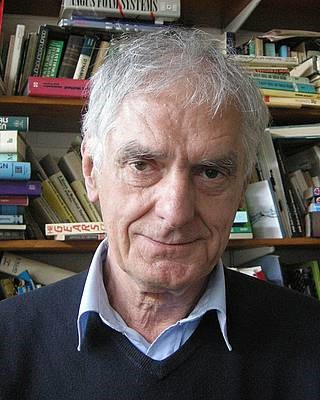
Professor Stephen Salter, grandfather of wave power
Salter later said in this interview about marine power:
Our programme was in the hands of the UK nuclear agency. Our reports and numbers were deliberately altered. They wanted us to fail. The official who did most damage to us was then put in charge of public relations for the Dounreay nuclear reactor.And because the UK had good wave resources the world was told that if we can’t do it nobody can. (our emboldening.)
Professor Salter had to break up his team in 1987. The disappointment after what had been achieved must have been crushing. In a letter to the House of Lords committee on renewable energy, you can hear his despairing frustration when he writes:
We must not waste another 15 years and dissipate the high motivation of another generation of young engineers…
We must stop using grossly different assessment methods in a rat race between technologies at widely differing stages of their development. We must find a way of reporting accurate results to decision makers and have decision makers with enough technical knowledge to spot data massage if it occurs. I believe that this will be possible only if the control of renewable energy projects is completely removed from nuclear influences.
It seems like leaving the UKAEA to oversee the renewables programme was like leaving the fox in charge of the ducks. Once again, a great and clear idea was suppressed, once again a great liberator was hushed up, once more condemned by the simple means of falsifying evidence and by having control of the message.
Salter’s Duck is still the best design, and it’s waiting to be called into action one day. Soon there’ll be a printer that can print ducks, and the price will plummet some more. Maybe some plastic microducks can be designed, like the micro-CSP, just to get a few kW out of calmer water, like rivers. A toy version for use at bath time would shift a few units. And a vision of giant ducks comes to us, for the most ferocious storms, harvesting a huge amount of energy and protecting the coast from the storm by removing the energy from it.
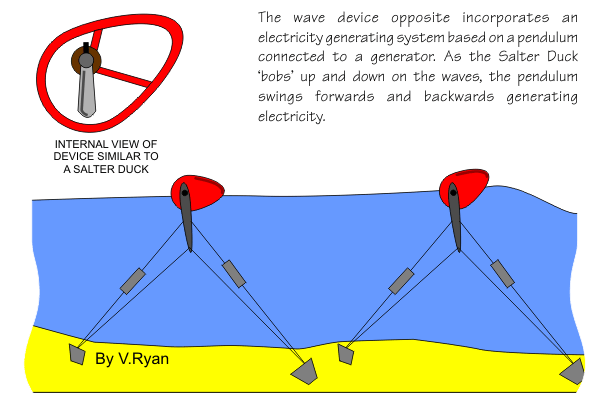
The developers of devices have kept moving forward. Although the duck is the daddy with its 90% conversion rates, there’s plenty of other ideas around harvesting the power in the sea. There’s lots of different designs here, on this page of wave and marine energy in general. The page includes V Ryan’s picture of a device based on Salter’s Duck in some action, which we’re thrilled to paste here in full working order:
The US Department of Energy have identified the north-western coast of the United States as one of the strongest wave-energy areas of the world. They calculate that wave energy could produce 40–70 kilowatts (kW) per metre of coast, with an average of about 1.6 Mw per 100 feet, a Gigawatt every 36 miles, which is distinctly less ambitious than Salter’s plans for the Duck.
This link is about the European Marine Energy Centre which is located in the Orkney Islands of Scotland, and about othe Japanese company that’s working there. Japan has great potential for wave power on its Pacific Coast, and a history of research in this area going back to the 1960s. Devices are developing. There’s plenty going on in Australia, too, where there is also great potential.
China, India, South Korea, Russia, many countries have wave energy research going on. There’s a lot of activity Britain would have been right out there on by now, if the last 30 years had been spent developing the science of harvesting waves. Fools.
Pelamis were an exciting development in Scotland, and the next time we looked, they’d folded, which is a great shame. Should we edit them out? No. Pelamis were the first company to actually deliver wave energy generated electricity to the national grid, from its site in Scotland, using machines designed by Richard Yemm, who studied under Salter. Pelamis say there are only very few days per year that waves are too weak to generate electricity. The Pelamis is built to survive and writhes with the water.
It seems from this story that the general design will be seen again shortly.
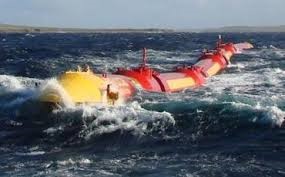
Stephen Salter still remains convinced of the potential from marine power in general, and points out that you could run continents with this sort of power.
And particularly around Scotland, where Pelamis was deployed, there are places where the great power of the Atlantic Ocean is squeezed through tight places and is there for the taking. Such a place is the Pentland Firth, where the Atlantic surges between Scotland and Orkney in an immensely powerful tidal stream.
Salter says:
There I think we should build close-packed turbines in deep water.
At peak spring tides we are now looking at about 240 to 250 Gigawatts of power being dissipated as friction on the sea bed. We should be able to convert about a third of that into electricity. That’s about 80 Gigawatts—more than the whole of the UK uses. We could build up to this in chunks of 50 Megawatts.
This is just about Pentland Firth.
The seabed machines being developed for this seabed harvesting include the Oyster, developed by Aquamarine Power, and they have Stephen Salter, now called the grandfather of wave power on the team.
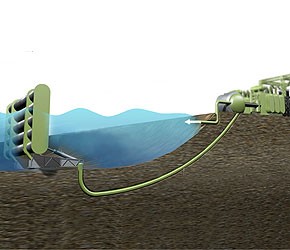
Image: Aquamarine Power
An Oyster is fixed to the seabed and is driven back and forth with the waves. This energy is captured as high-pressure water which is pumped onshore where it drives a turbine to generate electricity. It’s definitely not the prettiest thing, but it doesn’t matter.
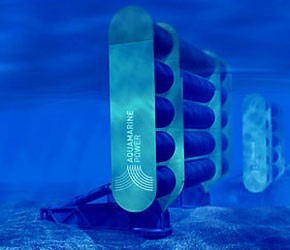
http://www.sciencemuseum.org.uk/antenna/wavepower/
Stephen Salter keeps working, on all sorts of things (more in other notes.) He’s got a strong sense of the trouble we’re in and the need to do something.
ScottishPower Renewables (SPR) are installing a demonstration array in the tight Sound of Jura, possibly using 10 of these machines:
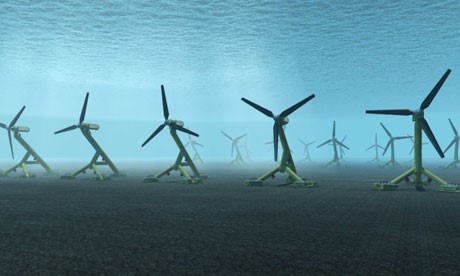
These are 1 MW Andritz Hydro Hammerfest tidal turbines. They look simple and cheap, a few thousand of these can be readily imagined, and no one is going to complain about their view being spoiled.
Anyway, 40GW here, 80GW there, if Scotland really went for it they could be harvesting truly enormous amounts of energy, perhaps enough for Western Europe, certainly enough to be a natural power powerhouse. 40GW here, potentially GWs anywhere. It would be exciting to see what Kitegen could achieve given a few lively square kilometres of, say, the Isle of Harris to play with; they’d have a 1,600 metre diameter turbine whizzing around.
The problem would be getting all the energy that’s around to where it’s needed, and the solution is to build some much needed infrastructure. If anything could justify public funding, it’s this, and then what Desertec are talking about can really happen . . . bang, just get the energy issue, the pollution issue, the security issue, all dispensed with and out of the way in one huge effort, as if it’s wartime, which it probably really is if we knew it. Create an abundance. All it takes is some engineering. Bang, there it is, all the energy you want, and more being added at the micro level all the time.
It is a bold move, but then again, it’s not, because the happy outcomes are completely predictable. And because the necessary sums are going to be spent – and probably wasted – anyway.
With nuclear building, it seems very predictable that a lot of the costs are going to turn out to be much higher than predicted. It’s claimed here:
In assessing the economics of nuclear power, decommissioning and waste disposal costs are fully taken into account.
But how can they be fully taken into account if the costs are an ever evolving picture? And they are.
This is what The Telegraph tells us here about the UK’s latest wave of nuclear building. Maybe £17bn of public subsidy!
Is this potential £17bn part of the Kwh calculations of the price of the energy? We don’t know. But £17bn! And would that be the end of it? £17bn, we imagine, would easily be enough to extract 80GW out of Pentland Firth and build power transmission lines out to the Western Isles to collect GigaWattage from the wild forces there. Or build maybe 250 Kitegen parks, farms and plants, which would be much more than anyone needed, and this just from the sum of a feared public subsidy to a private company. Why aren’t we allowed to vote to say where our immorally taken taxes go to? Would people choose to make such uses of £17bn if they had the full story?

The Turning Tide
Where there are suitable estuaries in the world, it’s easy to construct tidal barriers (and this is lunar power), which trap large volumes of water at high tide and use the differing water levels, releasing it at low tide to drive turbines, and then letting it in at high tide and capturing that flow also. There’s been one working very well at La Rance, in France, since 1966. It could have been built bigger and there’s a second stage that could be built which would be just helping themselves to some free energy.
Stephen Salter explains that it’s run by EDF, the French nuclear company who also build in the UK. EDF have never published the costs of the La Rance project, and presumably don’t want to build the second phase because they don’t want the figures to get even better.
It seems like the nuclear industry’s involvement in renewables is for the purpose of discrediting renewables, gathering evidence that they are uneconomic. They shower enthusiasm into the projects at the beginning, but when the costs start getting good and they start to make economic sense, then they hide the findings and/or lie about them.
Actually, Wyre Tidal Energy, who have long had plans for a barrage on the River Wyre in Lancashire, had these figures about La Rance:
With a peak rating of 240 Megawatts, generated by its 24 turbines, it has an annual output of approximately 600 GWh. The development costs were high but these have now been recovered and electricity production costs are lower than that of nuclear power generation (1.8c per kWh, versus 2.5c per kWh for nuclear).
That’s been the situation for renewable technology, that the development costs are high, but once in place, those costs are recovered and after that it’s much cheaper; even much, much cheaper.
Here’s a recently announced scheme for Swansea Bay.
This is a proposal from Tidal Lagoon Power, who want to build four lagoons around Britain to produce 7.3 GigaWatts, over 10% of the UK’s electricity demand. The whole idea of tidal lagoons is very interesting and offers protection from storms:
There is enormous power in the sea and marine energy will have a huge role to play in the future in all sorts of places. But for another view about Wave Power here’s a piece by Dr Kerry Black. Dr Black is a surfer . . . he says to keep energy simple and that some things are sacrosanct. We think he’d like kites.

Stranded Assets
Is it really possible that Natural Energy isn’t truly the way to go? Is it? In fact, there will be no other way to go.
We’re very confident that the KiteGen projects and Altaeros’s BATT, and the Desertec initiative and Ockels’ projects and all at the University of Delft, and Rawlemon’s Betaray, and Skyfuel’s ReflecTechPLUS and thousands of other projects, big and small – especially small – already have irresistible logic and momentum; and if we can give that a tiny push as well in terms of developing awareness, we’ll be very proud to do that.
It’s all definitely happening, it’s just a question of how quickly. Something is definitely afoot in the world, suddenly stats like this are appearing. This article says that:
According to the latest Energy Infrastructure Update report from the Federal Energy Regulatory Commission’s Office (FERC), 92.1% of new electricity generation capacity in the US in January through March of 2014 came from renewable energy sources.
Earlier we used a term we’d heard, stranded assets.
And here’s an article about Queensland, where the price of electricity fell below zero for several days. The author makes the sensational claim that if coal were free, it still couldn’t compete with distributed solar power. This is all being caused by installed solar power on people’s rooftops.
Queensland has become a prosumer market, where individual people are taking ownership of energy generation, and the coal-burning energy companies are starting to struggle badly. That’s a bit of a revolution going on there in Queensland, just take control of energy generation. And the sun is strong on most of the world’s territories.
This article says Solar has won, but not everyone accepts it yet.
Here, Bishop Desmond Tutu is calling for a global boycott of the fossil fuel industry. Fossil fuel divestment campaigns are starting to have an effect as investors start to understand the future for the hydrocarbons still in the ground that they’ve invested in:
UN climate chief, Christiana Figueres, has said to The Guardian:
If corporations continue to invest in new fossil fuels, they are really in blatant breach of their fiduciary duty, as the science [of climate change] is abundantly clear.
Among many others, The Guardian is concentrating very hard on this.
Leave it in the ground.

The Third Industrial Revolution
We refer in The World’s Progress Without Justice to the idea of the Third Industrial Revolution and to Jeremy Rifkin’s book of the same name, and to the age of lateral power he sees emerging. So, we will be repeating ourselves further on a little, but the news is so good it bears a little repetition. Jeremy Rifkin has an interesting story, too:
In an article here that we’ve already mentioned, Jeremy Rifkin, who, by the way, studied at Philadelphia University, talks about his vision of the Third Industrial Revolution here, and here in the World Financial Review. Here’s another piece, from the Huffington Post, and this one from the WFR, where he talks about the collaborative commons.
Rifkin compares Natural Energy to information and how Internet technology and renewable energies are merging. He points out how the rate of natural energy technological improvement and the rate the cost is falling is accelerating. He predicts that as the distribution of information is becoming nearly free, so natural energy will follow.
Rifkin talks about an energy Internet, an Intergrid. Continent-wide smart grids that work exactly like the Internet. Smart grids are bidirectional, they work both ways, electrical energy can be taken out of it and fed into it. An Intergrid would allow businesses and households to produce their own energy and share it, in the same way as emailing attachments or downloading from a website. This sounds fantastical alright, but – what a surprise – such systems are already being developed in Germany.
It’s all happening in Germany; there’s even a zero emissions aeroplane flying around.
This is what buildings in Germany are starting to look like:

For a fair amount of the time, this building will be feeding electricity into the grid, once it’s all set up; and it will be.
Jeremy Rifkin sees new buildings, adapted old buildings, acting as positive power plants capturing natural energy, feeding surpluses into the grid. Technologies are there to provide this: houses, offices, that are power plants. This is hard to imagine, with the kind of buildings we’re used to, that they could be power plants. Actually, though, we stress, Germany already has about a million such buildings. The world will need to catch up with Germany.
The pretty village of Wildpolsried actually produces, cleanly, 321% more energy than it wants, and sells the rest to the national grid for €4 million.

Hydrogen
The storage and regulating the supply of naturally generated energy has always been a crucial issue. It’s always been plain that renewables could produce huge quantities of energy, but not necessarily at the time it’s required. The solution to this is hydrogen.
Hydrogen is the simplest, most abundant element in the universe. It is never naturally present as itself on Earth, it’s always bonded to other elements, like oxygen in water, and to carbon, as the energy in hydrocarbons, and the energy in carbohydrates. It can be isolated from water with electric current in a process called electrolysis. Once isolated, it’s a potent, high energy fuel, it’s literally rocket fuel, powering NASA’s rockets for the last three decades. But when it’s burned, it burns cleanly, with its byproduct being water. The energy released comes from the chemical reaction of the hydrogen recombining with oxygen – producing H2O. In fact, the crews on the Space Shuttle actually drink the waste product of the hydrogen fuel cells which provide the power to the craft’s systems.
The use of hydrogen as a fuel is another of those technologies which were cracked a long time ago and would have been perfected by now, had they had a fraction of the investment that tank armour has had, or the amounts lavished on missile guidance systems. The means of industrially isolating hydrogen from water goes back to the work of Russian physicist Dmitry Lachinov back in 1888, when Henry George was still enlivening people with his speeches.
And anyone really interested in hydrogen should read Lindsay Leveen’s work, which is a comprehensive overview of the whole subject.
And we read Kaveh Mazloomi’s paper: The Electrical Efficiency of Electrolytic Hydrogen Production
The paper says that commonly, the industrial electrolyzing process has a nominal hydrogen production efficiency of around 70%. There are certain technical issues that cause the 30% loss which are certainly within reach of solutions and that will surely succeed with some investment, and this paper provides an insight into these factors and the attempts to reduce this energy loss.
In the presence of abundance, 70% is good. And the process creates oxygen, as well, which maybe offsets a tiny bit of the cost. And if abundant oxygen is being created it could be released into the atmosphere to dilute the carbon? Does it work like that? It’s certainly a much sweeter emission, that’s for sure.
The world’s first public hydrogen filling station is in Reykjavik, Iceland, and it powers three hydrogen powered buses, puffing water vapour into the streets.
Hey, let’s have a picture of a bus, a hydrogen powered bus:

So, excess electricity in a continental Intergrid system can be diverted into electrolysis and hydrogen fuel cells created, for an energy regulator and reserve and for transport.
And very interesting recent developments from Tesla in battery technology.
Jeremy Rifkin, author also of The Hydrogen Economy, sees the vehicles of the future being electric plug-in vehicles and hydrogen fuel cell vehicles, exchanging energy with the Intergrid, at times actually functioning as providers to the grid, maybe even storing energy for the grid at peak output.
The Third Industrial Revolution society he sees is of millions of people producing their own information, energy and manufacturing, millions of microfactories, using the fast emerging culture of additive manufacturing, or 3-D printing, child of the WorldWideWeb.
This is also a huge factor in considerations about energy, because additive manufacturing, as opposed to subtractive manufacturing (a nice retronym that’s emerged) massively reduces the energy and resource demands of manufacturing.
We’ll use this quote again because it sounds so good to us:
When Internet communications manage green energy, every human being on earth becomes his or her own source of power, both literally and figuratively. Billions of human beings sharing their renewable energy laterally on a continental green electricity internet creates the foundation for the democratization of the global economy and a more just society.
What Jeremy Rifkin has described is irresistible and inevitable. All of this is a clear effect of the global Web, a revolution which will continue to unfold. This is very hopeful. This could be the golden, clean, democratised future of creative lateral power, power that comes from the common access to the unownable.

footnotes
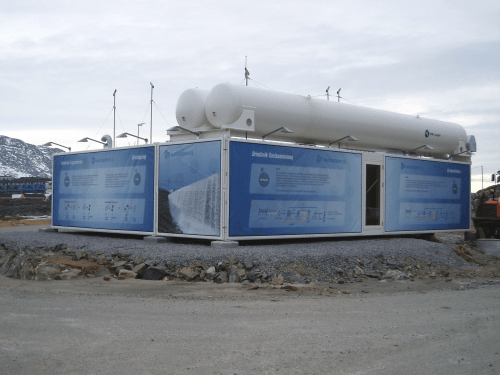
This is what a hydrogen producing plant looks like. This is in Greenland, a country self-sufficient in clean power; (at least until all the ice melts that’s providing so much hydroelectric power.) And with spare energy, Nukissiorfiit, the national energy company, bought this plant from H2 Logic in Denmark.
The Real World
But back to today and the unfortunate real world, which is how it would be described by the toxic titans that still stand, entrenched, in the way of that vision. Jonathon Porritt, who’s been trying for years, has sadly concluded that engaging with oil companies on climate change is futile.
In the UK, we mentioned the new nuclear build and whatever it’s going to cost in the end. And there’s a troubling background to it.
There is no existing example of the EPR, European Pressurised Reactor, that the UK are buying. Two that are under construction are in France and Finland, the one in Finland was meant to be finished in 2009. Both projects have been dogged by worrying design faults, dodgy construction and improperly welded reactor containment. Finland commissioned theirs for €3 billion, which has now become €8.5 billion, although the Finns are confident it will be finished in 2020. It’ll be interesting to see how much it costs by then. The French project is similarly over budget, troubled and delayed. What on Earth has the UK bought here?
Peter Wynn Kirby at the University of Oxford explains and makes some worrying points.
And, of the question in general, so does this story of mistakes at a Cumbrian nuclear dump – how scary can this get?
The real danger isn’t just from the nature of the fuel itself, it’s the certainty that it’s going to be run by companies under intense pressure to cut every cost. A corner is cut here, then that practice becomes normal, and just a little more, and moral hazard creeps in.
The trouble with dealing with something that is truly terrible is always that mistakes can be made, even with the very best will in the world. It’s impossible to feel safe about nuclear energy, especially as it’s been long demonstrated that what we’re told is invariably a lie. So, now we’re going to make another big pile of waste to store forever.
And the other big energy news item has been fracking, hydraulic fracturing of rocks deep underground to release shale gas. Having bought a dodgy reactor at unknown huge expense, the government has made clear we’re going headlong for shale.
People are very upset about fracking, and it does sound an extreme measure. People have reacted with great emotion about it, like it’s an assault too far on Mother Earth. It’s an instinctive reaction that fracturing rocks underground, beneath our feet, just seems a very bad idea, that it’s too obviously asking for a lot of trouble at some time.
But experts present a very rational explanation of it.
It does sound reassuring; it can all be handled safely if done absolutely strenuously correctly. Wells will never leak, because of … technology.
So, we were shocked to read the very alarming claims made in this article by Natalie Hynde following her arrest at Balcombe in an anti-fracking protest:
She says here:
Anyone can Google the “List of the Harmed” or look at the Shalefield Stories detailing what’s happened to people in the US as a result of fracking – the nosebleeds, the cancers, the spontaneous abortions in livestock, the seizures and silicosis in the worker’s lungs. Not to mention the farming revenue lost from sick and dying cattle. When you have exhausted all other channels of democratic process – written letters, gone on marches and signed petitions – direct action seems the only way left to get your voice heard.
Actually, you can Google it, or you could use another internet search facility. And she says:
In the US, this industry has buried people’s stories and threatened their livelihoods if they dare to speak out. Researchers from the Colorado School of Public Healthhave found that a number of toxic, and carcinogenic, petroleum hydrocarbons in the air near fracking wells include benzene, ethylbenzene, toluene and xylene, which cause acute and chronic health problems for those living nearby.
So, either it is completely safe, and a lot of misguided, unrealistic people are making up a lot of lies about it. Or, it is certifiably diabolically bonkers, and corporations/governments are somehow suppressing a lot of stories about what’s really happening.
It’s a tough one, isn’t it? Whichever it is, it certainly feels desperate.
The played out scenario of this dash for gas in the UK, seems to look like this: Each site would be about the size of a cricket ground, each attended by a constant stream of heavy lorries, and each site would need millions of gallons of fresh water which afterwards has to be treated as toxic waste. To start to make any big difference to energy supply and independence, there would need to be around 20,000 such sites around the country.
It is pitiful to imagine what that would look like. A country that has disfigured and uglified itself, perhaps poisoned itself, in order to keep the lights on. It is desperate. What the world needs to know is what Kitegen could do with a cricket ground, indeed, a Carousel around a cricket ground would be a most wonderful thing; sometimes swift shadows of distant kites would flicker across the wicket, and that would just be a part of playing on that wicket.
Hynde makes the crucial point that nothing in this country is in place to deal with thousands of millions of gallons of toxic waste water. When it comes to it, it’s obviously going to be dumped in estuaries. And then we’re talking about causing long-term damage to the ecology of this country, at the very least.
And thousands of millions of gallons of fresh water in the first place? This, in a crowded country that is sometimes water-stressed, sometimes flooded, may well become increasingly more so. Intuitively, fracking has got multi-layered disaster written all over it, a great big horrendous mess. It is desperate, and so, so unnecessary.
What is for sure, as OCI point out, is that extractive industries are necessarily getting more extreme:
It’s almost as if major corporations have decided that the world is totally screwed anyway, so this is the time to get hold of whatever resources are left in the world. The party’s going to end, anyway, no point in stopping now. Lands are to be ripped up to get the last bits of juice to keep the party going a little longer, suck every last bit of blood of every last stone and grain.
Of course, in fracking’s context, some kind of nod needs to be made towards greenness, and so fracking’s champions use language that suggests that the shale gas extracted is some kind of clean fuel, it comes over as a greenish kind of gas. The UK Prime Minister David Cameron has even claimed clean. He says:
If there’s an opportunity to extract clean, low-cost gas from shale in the UK we would be making a great mistake if we didn’t enable this industry to develop.
It’s certainly much nicer than coal, in that it doesn’t deposit mercury into the soil, but shale gas is not even low-carbon, let alone clean. The chemicals used in the rock fracturing process aren’t clean, they’re acutely carcinogenic.
Craig Bennett’s article sets it out fully.
As for low cost; of course, this totally skewed way of calculating cost is one of the world’s major issues.

http://www.theguardian.com/commentisfree/2014/mar/31/ipcc-report-world-lose-habitats-climate-change
A poignant picture of fracking in California illustrates well the futile desperation of the dying hydrocarbons age, busily fracturing rocks deep underground, seemingly oblivious to that great furnace in the sky above them, even in California. The Sun is setting on them.
Peter Lilley even described shale gas as a modern fuel. It’s not modern, it’s patently ancient fuel, being obtained by the traditional brutal methods of extractive industries. What is modern is the development of high precision engineering to harvest the huge quantities of naturally occurring energy that we’re swathed in. Modern Fuel, indeed.
There is a frantic lunge to hold onto the old certainties, the hard hats, business as normal. It’s a crazed attempt to carry on life as we’ve known it, as is biofuels, growing food for cars. It’s like a last yearning for business as usual, a desperate attempt to hold onto a passing age.
Maybe it is just as George Monbiot says, where he explains that the government’s enthusiasm for fracking arises from something it shares with politicians the world over: a macho fixation with extractive industries.
A very scary thought is that, if all of provisions of the Transatlantic Trade and Investment Partnership (TTIP) were in place, even as a free nation we wouldn’t be able to decide to leave it in the ground, because we may then be sued by corporations for the profits we wouldn’t be allowing them to rip out of the country.

Fusion
Of course, if this happens . . . Nuclear Fusion will apparently change everything, and then power would be limitless and clean. Except that . . . fusion will surely guarantee the existence of big centralised power, sustain the philosopher kings, create a new fusion power elite and bring on all the concomitant security demands, etc. Because nuclear fusion would have to be done with some big piece of kit, etc., who knows? We don’t even know what it would look like, but it sounds like something which would demand a lot of authority and security.
Enough. Natural energy harvesting guarantees the independent existence of individual agency and power at the common level. No more central powers, just lots and lots of small operations, down as far as the household.
Fusion isn’t the way to freedom, it would mean continued close supervision and serfdom; unless fusion turns out to be something that anyone can do in a bucket of cold water, but, according to our calculations, this still looks unlikely.
If nuclear breeder reactors are developed, they could use up all of the nuclear waste in the world, and indeed there would no longer be any such thing as nuclear waste, as it would all become redefined as unspent fuel. It would be the solution to that problem. Build them somewhere remote, use all the waste up, then when the last rod is burnt dry of radiation, close them down. Build them on the Moon, because this is a place for life.

Energy and Economic Justice
We noted earlier the political power implications of different forms of energy generation, and we noted the level of subsidies received by the massive corporations involved in energy extraction. The other part of this is that hydrocarbon revenues are due to Land, whereas the revenue from renewable energy harvesting essentially derive from Capital. In the just conditions of Henry George’s Remedy, the tax burden on Labour and Capital wouldn’t be there, and economic rent would be collected from Land. The price comparison between modes of energy, the actual accurate figure, would then look damningly different.
Energy generation at the moment comes from that part of the commons, of Land, which been taken into private ownership, monopoly; while renewable energy, driven by the wind, driven by the Sun, comes from the part of the commons, of Land, which has remained unownable.
A just public revenue system, taking resource rents and not taxing capital equipment, would produce a bloom in the development and deployment of some of the microgeneration systems featured earlier in these notes. Inherent in the Remedy are the correct economic incentives that are needed to face the future.
The Remedy, economic justice, has a huge implication in terms of the energy wasted by our current system and the environmental destruction caused by the current arrangements of land tenure. As cities grow wealthier, large areas are locked away for land speculation. After all, in the current circumstances, it’s a banker. This causes leap-frog development, and people who work in the enterprise zone that is a city, are forced further and further out to find an affordable home. The facilities and services that a population needs then become stretched, and everything becomes more expensive, polluting and energy intensive, people are pushed further and further out of town and people who work in the city have to lose more of their day travelling, uncomfortably, as a captive clientele for the rail rentiers, as well as to all the other forces they’re captive to.
Within the city, the absence of just arrangements is reducing London to this, to a kennel.
Meanwhile, The Campaign to Protect Rural England have identified that:
In England there is sufficient brownfield land available and suitable for 1,494,070 new dwellings, and much more on top of this suitable for business or industrial development. In Northern regions (the North West, Yorkshire and the Humber and the North East) there is enough brownfield land for over 444,000 new homes. Even in the South East, where housing demand is highest, land supply outpaces demand with one quarter (26 per cent) of suitable brownfield plots going unused.
If we could start the programme to bring in the Remedy tomorrow, one immediate effect would be that land speculation would immediately become uneconomic. Huge amounts of brownfield land would become available – 31,000 hectares in London alone, large scale housing could be built inside London.
Nationally, 1.5 dwellings, housing six, seven million people. That would certainly improve national wealth. 1.5 dwellings being built would have a huge downward pressure on property prices, which is probably why politicians couldn’t countenance it, because property prices, above all, appears to be their measure of economic success in this bizarre upside-down real world.
In the UK now, the term generation rent has become current.
Building dwellings on this brownfield land would present a huge opportunity to build 1.5 power generating buildings of the kind Germany build. It can be done. It really can all be done. It would be easily funded, as well. Just do it. Wake up and do it.
Application of economic justice would mean that huge amounts of energy would be saved as a result of infill development, and cities would work so much better in every way, as people’s homes. The Remedy would take away the brownfield blues.
Deeper understanding of the full effects of Henry George’s remedy reveal that, far from being observations from a far-gone agricultural age, they have never been as searingly important, and, naturally, provide all the correct incentives for addressing biosphere distress. It’s all for future and deeper study, Lindy Davies’ afterword to The Science of Political Economy is a very good starting point.
As he says, of the complexity of the questions ahead:
– the fundamental principle that the value of natural opportunities must be collected for common benefit is a powerful de-obfuscatory tool, as useful in the academy as it is at the grassroots.
(For further analysis, take a look at Mason Gaffney’s Economics in Support of Environmentalism)

Natural Energy is Obvious
Natural Energy is obvious, it’s obvious to a child. We know this having been children. There’s no way, in the end, that the ways we generate electricity are in any way better, cheaper for anyone. They are destructive and disastrous by every measure. Natural energy is free. Of course, it’s not free, but, practically, it is. The infrastructure isn’t free, but nor is it for anything else, and the infrastructure pays for itself fairly soon.
The power source is free, and it’s clean, abundant and infinite. There are gigawatts everywhere. Just reach out and take it. It doesn’t matter that some of these systems aren’t productive for 10% of the time, there will always be massive power coming from somewhere, and the supply regulated by massive power in reserve stored as hydrogen. Better sooner than later.
It should be stressed that there’s a lot more to renewable energy than has been covered here, this note is just the Staneb Natural Energy Greatest Hits. We apologise to all the pioneering companies that didn’t get a mention in these notes, it was largely happenstance (as was reading Progress and Poverty in the first place, which led to any notes being made about anything at all.)
Loads more fascinating stuff we found just in passing here.
Hopefully we’ll catch up with all the energy pioneers by and by and add some notes, for there is much that hasn’t been mentioned. Further notes are planned about all the other means of harvesting natural energy. Energy is Everywhere.
Anyway, that really is plenty to be going on with and will suffice for the sleeve notes to explain why we’re the Single Tax and Natural Energy Band.
We want to promote natural energy and help usher in a new age. There is so much it would be so good to get rid of, that has been so destructive to the biosphere and to human society. To say goodbye to toxic pollution, biosphere distorting emissions, oligarchical corporate political power, security states and all that God-awful malarkey, and begin to make repair and recompense for what’s done.
If there’s super-abundant dispersed energy, power, most other things can be done. Whatever it is we’re going to have to do in the future to keep the world’s population alive over the next century, and thriving. With abundant energy, water can be produced. Heaven forbid, but food can be synthesised. Abundant energy, available anywhere, is the primary issue, really: that provided, almost anything else becomes possible.
Energy can be used to suck carbon out of the atmosphere. There are artificial trees that absorb 1,000 times more carbon than real trees, scrubbing towers that draw in air and releases it at the top with half of the carbon taken out. This will develop. (further notes to follow.) With abundant energy generation, the Sun could start to suck the air clean.
It’s just a fantasy at the moment, but for an island like Kiribati, home to 100,000 people, whose looming fate is to be overcome by rising sea levels and disappear completely, could not a huge wall system be built around it like the ones proposed for Swansea Bay Lagoon? And the island then becomes a massive generator of energy through tidal storage power. They could not easily export the energy, being right in the middle of the Pacific, but they could make income by diverting their huge mass of surplus energy to removing carbon from the atmosphere, which in the near future will surely attract income, an international price agreed. This is a very interesting interview on carbon mopping.
It doesn’t matter where in the world carbon removal takes place. If there was a guarantee for this future income, that could pay for the wall that would save Kiribati and many other islands. It would be much less of a tropical paradise, but it would be there. Could there possibly be the international political will to bring about these things? There’s certainly the technology in the world to save everyone, there’s no doubt about that.
There is always hope. This is very hopeful.
Seems there is such a thing as the progressive corporate sector, which shouldn’t be a complete surprise, we really are all in this one together. The article says:
The progressive corporate sector plans to make a major push at next week’s climate change summit in New York for the introduction of a meaningful global price for carbon, believing it to be one of the most effective measures to keep temperature rises within 2C.
And further that:
CDP, the sustainable-economy non-profit, has compiled the first global database which shows that the world’s largest corporations are outpacing their governments in responding to climate change and expect carbon to be priced.
CDP are the Carbon Disclosure Project, and say:
CDP is an international, not-for-profit organization providing the only global system for companies and cities to measure, disclose, manage and share vital environmental information.
Sir David King argues for £15bn a year R&D spending on clean energy to make it cheaper than coal power globally, in emulation of space race research efforts
£15bn, from the whole world, the equivalent funding that the USA gave the Apollo programme, which so thrilled the world with in the early 70s. £15bn is nothing, of course, a small fraction of a bank bail-out – to give us at least a sniff at being able to save the world. If that’s what it would take to make the key difference, then it is criminally insane not to do this.
Here’s David Attenborough talking about this idea.
Again, energy should be produced in such abundance that eventually it is an omnipresent resource for the whole global community. Such abundance that great stores of energy can be made. Such abundance that extravagant use of it can be put towards damage limitation and cleaning up.
Can we hope to somehow heal the world? We’re bound to hope that. And if there’s abundant energy available everywhere, it feels like there’s a chance.

 Wake Up: Alarmed Pop Music and Answers